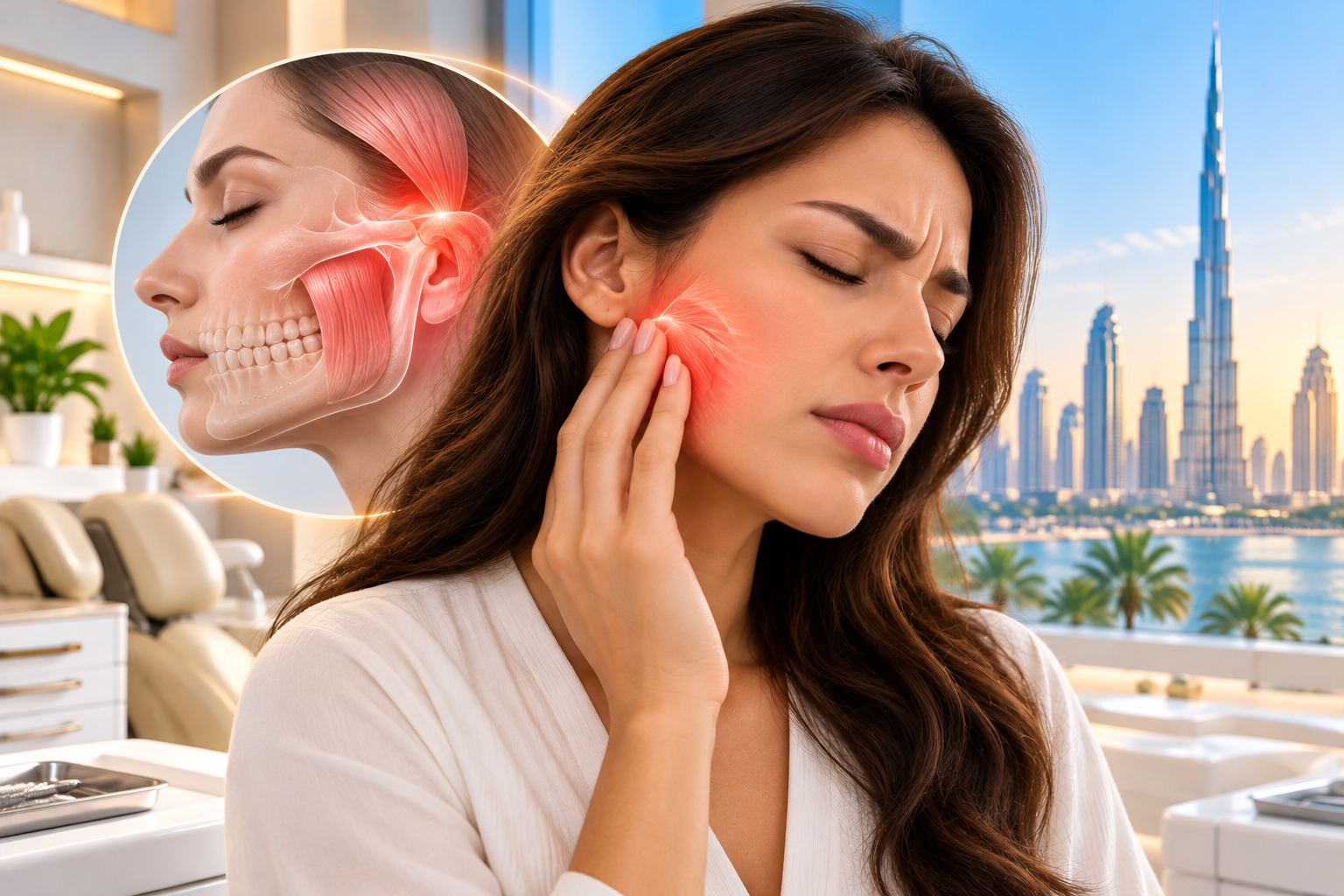
Why Is Everyone Suddenly Clenching Their Jaw? Stress, Botox and What Actually Helps
Masseter Botox has moved from a niche aesthetic treatment to a mainstream one, with clinics reporting a sharp rise in demand for jawline slimming, and a large share of those patients arriving because they clench rather than because of how their jaw looks. That overlap is the opportunity. People searching for the cosmetic fix have a dental problem, and almost nobody is writing the honest version of this for a Dubai audience. The post ranks on a trend term and converts into night guard and bite assessment bookings, which the clinic already prices at AED 500 and AED 800.
If your jaw aches when you wake up, if your partner has mentioned a grinding noise at night, or if the sides of your face feel tight by the end of the working day, you are in a very large group. Jaw clenching has become one of the most common complaints walking into dental clinics, and the number of people seeking treatment for it has risen sharply over the past few years.
Some of that is genuine increase. Most of it is that people have finally worked out what has been causing the headaches.
 What jaw clenching actually is
Clenching and grinding have a clinical name, bruxism. It happens in two forms. Awake bruxism is the jaw tightening you do while concentrating, sitting in traffic, or reading something irritating on your phone. Sleep bruxism happens while you are unconscious, which is why most people have no idea they do it until a dentist points at the wear on their teeth.
The masseter is the muscle that does it, running from your cheekbone down to your jaw. It is, relative to its size, one of the strongest muscles in the body. Used all night, every night, it does damage in three directions at once: to the teeth, which flatten and chip, to the jaw joint, which starts clicking and aching, and to the muscle itself, which thickens and becomes permanently sore.
Why it has got worse
Stress is the obvious driver, and in a city where long hours and long commutes are normal, there is plenty of it. But a few other things stack on top:
* Desk and screen posture, which pushes the head forward and loads the jaw and neck together
* Caffeine, which most people here drink more of than they admit
* Poor sleep, which increases sleep bruxism, and bruxism in turn worsens sleep, so the cycle feeds itself
* An uneven bite, where the teeth do not meet evenly and the muscles work harder to compensate
* Some medications and conditions, which is worth discussing with your doctor
The Botox question
This is where most people arrive. Botox injected into the masseter muscle weakens it, which reduces the force of clenching and, over a few weeks, makes the muscle smaller. That slimming effect is why it became popular as a jawline treatment, and the demand for it has surged. A significant share of the people asking for it are not chasing a jawline at all. They are in pain.
It does work for the right patient. It is also worth understanding what it does and does not do
| What masseter Botox does | What it does not do | |
|---|---|---|
| Reduces the force of clenching, so there is less damage | Stop you clenching. The habit remains, the muscle is simply weaker | |
| Relieves muscle pain and tension in many patients | Fix an uneven bite, if that is what is driving the clenching | |
| Slims the jawline as a side effect | Last indefinitely. Effects wear off over a few months and treatment is repeated | |
| Helps when muscle tension is the main problem | Protect the teeth from wear on its own, it reduces force rather than removing contact |
 What a dentist tries first
| Step | What it involves | Cost from | |
|---|---|---|---|
| Assessment | Examining the teeth for wear, checking the jaw joint and muscles, and looking at how the bite meets | AED 200 | |
| Custom night guard | A made to measure guard worn at night, which absorbs the force and protects the teeth. Not the same as a boil and bite guard from a pharmacy | AED 500 | |
| Bite adjustment | Where the teeth do not meet evenly, reshaping the contact points so the muscles stop compensating | AED 800 | |
| Habit and posture advice | Daytime awareness, screen setup, caffeine, and jaw relaxation through the day | Included in the assessment | |
| Orthodontic treatment | Where the bite itself is the underlying problem and needs correcting properly | From AED 5,000 |
What you can do tonight
* Check your jaw position right now. If your teeth are touching, they should not be. At rest the teeth stay slightly apart with the tongue on the palate
* Set a phone reminder twice a day to check it, because awake clenching is a habit and habits respond to prompts
* Lower the caffeine, particularly after midday
* Warm compress on the jaw muscles for ten minutes in the evening
* Raise your screen so you are not looking down, which loads the jaw and neck
* Avoid chewing gum, which is masseter training you did not intend to do
None of this fixes an uneven bite or reverses tooth wear that has already happened. It buys time and reduces the load while you get the thing assessed properly.
When to stop waiting
Book an assessment if the jaw clicks or locks, if you wake with headaches or jaw ache more than occasionally, if teeth have become sensitive or visibly flatter, or if the pain has started spreading into the ear, temple or neck. Jaw problems caught early are usually managed with a guard and some adjustments. Left for years, they become joint problems, and those are considerably harder to treat.
FAQ, also use for FAQPage schema
* Is masseter Botox good for jaw clenching?
It can help patients whose main problem is muscle tension and pain, by reducing the force of clenching. It does not stop the habit, it does not correct an uneven bite, and the effect wears off over a few months. Most dentists would try a custom night guard and a bite assessment first, because those address the cause rather than the symptom.
* How do I know if I grind my teeth at night?
Common signs are waking with jaw ache or headaches, teeth that look flattened or chipped, increased sensitivity, a partner hearing grinding, or tightness in the sides of the face. A dentist can usually tell from the wear pattern on the teeth.
* Does a night guard stop you clenching?
No, and no guard claims to. It protects the teeth from the force and often reduces muscle pain, because the jaw sits in a better position. The clenching habit is addressed separately through awareness, stress management and, where needed, bite correction.
* Is a pharmacy night guard as good as a custom one?
No. A boil and bite guard is a rough fit, which means it can shift at night and in some cases alter the bite. A custom guard is made from an impression of your own teeth and fits only one way.
* How much does a night guard cost in Dubai?
At our Al Karama clinic, a custom night guard starts from AED 500 and a TMJ consultation and assessment is AED 200. Emirates Platinum members receive 40% off.
* Can stress really cause jaw pain?
Yes, and it is one of the most common causes. Stress raises muscle tension, including in the jaw, and clenching often happens without any awareness of it, particularly during sleep.
Jaw pain, clicking or grinding? Book a TMJ assessment at Jesh and Mikh Dental Clinic in Al Karama, a short walk from ADCB and Max Metro stations. Call +971 52 100 0425 or message us on WhatsApp.