Why Does My Jaw Click? A Dentist in Al Karama Explains When to Worry
A clicking jaw is unnerving the first time you notice it. You yawn, something pops near your ear, and you spend the next week opening your mouth carefully to see whether it happens again.
Here is the reassuring part. Jaw clicking on its own, with no pain and no restriction, is extremely common and often needs no treatment at all. The part worth taking seriously is when it arrives with company.
 What is actually clicking
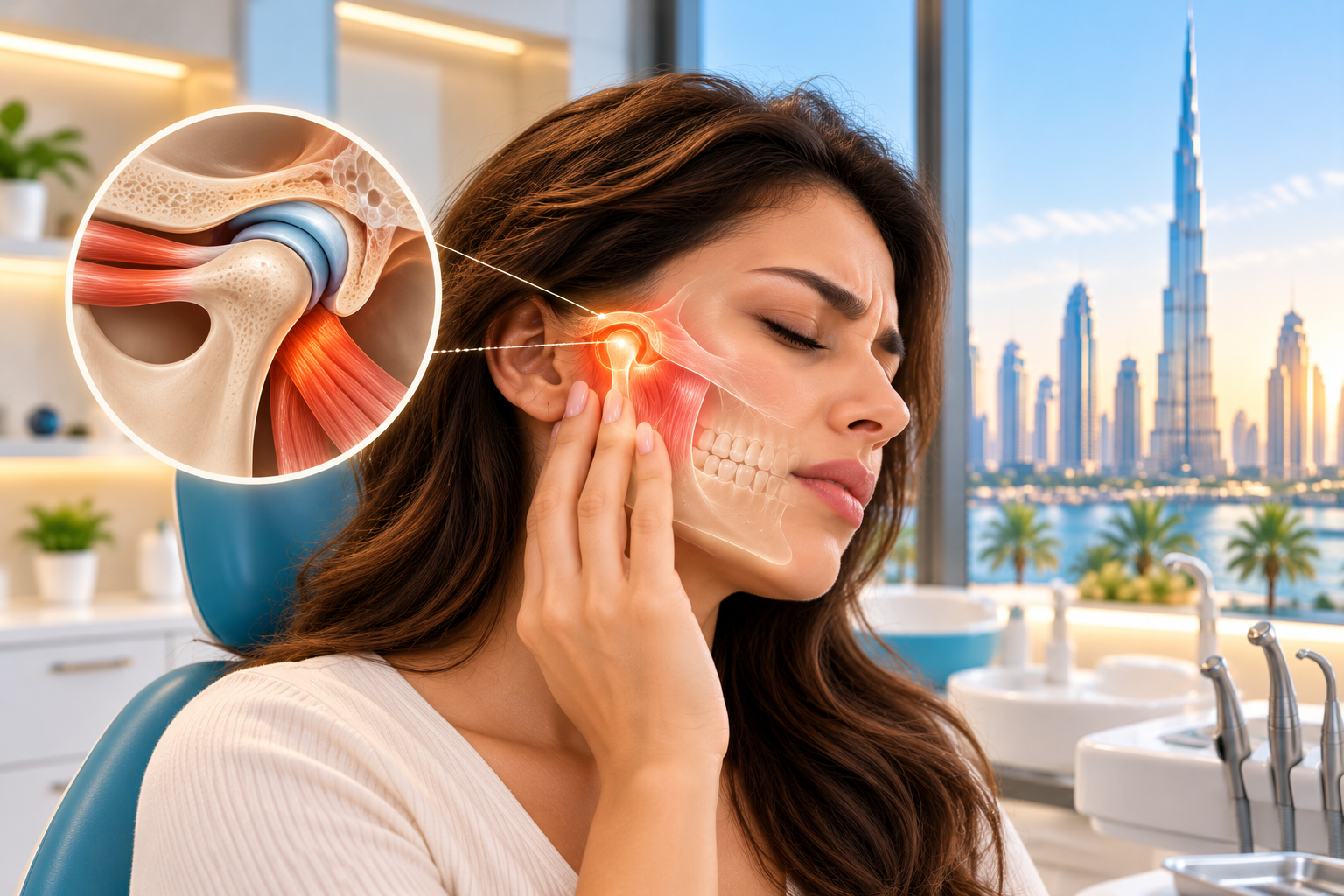
The temporomandibular joint, the TMJ, sits just in front of each ear and connects the lower jaw to the skull. Inside it is a small cartilage disc that cushions the joint and should glide smoothly as you open and close.
When that disc slips slightly out of position, it catches and then snaps back as you open. That snap is the click. It is a mechanical sound, not a sign that something has broken.
When clicking is nothing to worry about
* It happens occasionally rather than every time you open
* There is no pain in the joint, face or ear
* You can open your mouth fully without restriction
* It has not changed or worsened over months
* There is no locking, catching or deviation to one side
If that describes you, the usual advice is to leave it alone, avoid very wide opening and hard chewy foods, and mention it at your next routine checkup.
When to get it looked at
* Pain in the joint, the face, the temple or the ear, particularly on one side
* The jaw locks open or closed, even briefly
* You cannot open as wide as you used to
* The jaw deviates to one side as it opens
* Headaches on waking, or ache in the jaw muscles through the day
* Clicking that has become steadily worse, or has turned into a grinding sound
* Teeth that have become sensitive, flattened or chipped
* Ringing in the ears or a blocked feeling with no ear infection
A grinding or crunching sound is different from a click and is worth getting assessed sooner, because it can indicate wear within the joint rather than a disc slipping.
 What causes it in the first place
| Cause | How it leads to clicking | |
|---|---|---|
| Clenching and grinding | Sustained muscle load pulls the joint out of its normal relationship and inflames it | |
| An uneven bite | The teeth do not meet evenly, so the jaw muscles compensate and the joint is loaded unevenly | |
| Stress | Raises muscle tension, usually without any awareness of it | |
| Injury | A blow to the jaw or a whiplash movement can displace the disc | |
| Arthritis | Degenerative change within the joint, more common with age | |
| Habits | Nail biting, chewing gum constantly, resting the chin on a hand, sleeping face down | |
| Posture | Forward head posture at a desk loads the jaw and neck together |
What a dentist does about it
Most TMJ problems are managed without surgery, and most are managed without anything dramatic at all. The usual path:
* An assessment of the joint, the muscles and the bite, with imaging if needed, AED 200 at our Al Karama clinic
* A custom night guard where clenching or grinding is involved, from AED 500
* Bite adjustment where the teeth are meeting unevenly, from AED 800
* Muscle and jaw therapy, including exercises you do at home
* Habit and posture advice, which sounds minor and is not
* Orthodontic treatment where the bite itself needs correcting, from AED 5,000
* Referral on where a case needs specialist or surgical input, which is uncommon
What to do in the meantime
* Soft foods for a week or two, nothing that needs serious chewing
* Avoid very wide opening, support the jaw when you yawn
* Warm compress on the muscles for ten minutes, twice a day
Stop chewing gum entirely
* Keep the teeth slightly apart at rest, lips together, tongue on the palate
* Avoid sleeping face down with the jaw pressed into the pillow
If the jaw locks and will not open, do not force it. Book an appointment promptly rather than working at it yourself.
FAQ
* Why does my jaw click when I open my mouth?
Usually because the small cartilage disc inside the jaw joint slips slightly out of position and snaps back as you open. On its own, with no pain and no restriction, this is common and often needs no treatment.
* Is jaw clicking serious?
Not usually, if it is painless and occasional. It is worth getting assessed if there is pain, locking, reduced opening, deviation to one side, or if the clicking has been getting worse.
* Can a dentist treat jaw clicking?
Yes. Most TMJ problems are managed by a dentist without surgery, using an assessment of the bite and joint, a custom night guard where clenching is involved, bite adjustment, and jaw therapy.
* Why does my jaw hurt on one side only?
One sided jaw pain often reflects uneven loading, where you chew mainly on one side, clench asymmetrically, or the bite meets unevenly. It is worth assessing rather than assuming it will settle.
* Can TMJ cause headaches and ear pain?
Yes. The jaw joint sits directly in front of the ear and the muscles involved run into the temple, so TMJ problems commonly present as headaches, ear ache or a blocked ear feeling with no infection.
* How much does TMJ treatment cost in Dubai?
At our Al Karama clinic, a TMJ consultation and assessment is AED 200, a custom night guard starts from AED 500 and bite adjustment from AED 800. Emirates Platinum members receive 40% off.
* Is there a TMJ dentist in Al Karama?
Yes. Jesh and Mikh Dental Clinic treats TMJ and jaw pain at our clinic in Al Karama, Dubai, a short walk from ADCB and Max Metro stations, with parking available.
Jaw clicking, locking or aching? Book a TMJ assessment at Jesh and Mikh Dental Clinic in Al Karama. Call +971 52 100 0425 or message us on WhatsApp.